Recently, the research group led by Xiu Faxian from the Department of Physics at Fudan University, based on the anisotropic two-dimensional material ReS2 and the piezoelectric material LiNbO3, discovered an optoelectronic response anisotropy that can be modulated by surface acoustic waves. They also employed machine-learning algorithms to achieve simultaneous multi-dimensional detection of light. On April 10, 2026, the related findings were published online in the journal Science Advances under the title "Acoustoelectric Control of Optoelectronic Anisotropy for Reconfigurable Polarimetry" (Science Advances 12, eaec4337 (2026)). This work was jointly conducted by the research group led by Xiu Faxian from the Department of Physics at Fudan University and the research group led by Zhang Cheng from the Institute of Micro- and Nano-Electronic Devices and Quantum Computing.
Polarization of light is a fundamental physical property that, alongside intensity and wavelength, carries rich information and plays an irreplaceable role in fields such as optical communication, optical imaging, and environmental sensing. Traditional polarization measurement instruments typically rely on schemes involving time division, amplitude division, aperture division, or focal-plane division, requiring optical components such as polarizers, waveplates, and beam splitters to achieve spatial or temporal separation of the light field. Although these systems are effective, they tend to be bulky, feature complex mechanical structures, and are difficult to integrate on-chip. In recent years, a novel alternative has attracted widespread attention: harnessing the intrinsic anisotropy of low-symmetry two-dimensional materials to realize polarization-sensitive photodetection.
However, the response of a single anisotropic material exhibits twofold symmetry, making it impossible to distinguish between mirror-symmetric linearly polarized states and thus limiting its capability for comprehensive polarization characterization. To overcome this symmetry limitation, the academic community has explored various strategies, including stacking two-dimensional materials with misaligned crystal axes and integrating metasurfaces composed of nanostructures with engineered anisotropy. Although these approaches can expand polarization detection capabilities—for instance, enabling full Stokes parameter measurements—they rely entirely on the interlayer orientation or geometric structure defined during fabrication, making them inherently static and lacking dynamic tunability.
In this work, the research team proposed a novel approach: coupling surface acoustic waves on a piezoelectric substrate with two-dimensional semiconductors to achieve dynamic, in-situ control over the device’s polarization response. Surface acoustic waves consist of coupled stress and piezoelectric fields and propagate predominantly at the surface of the piezoelectric substrate. In their experiments, the research team transferred and stacked a thin layer of ReS2 onto a 128°Y-cut LiNbO3 substrate and fabricated interdigital transducers on the substrate surface to excite surface acoustic waves. The team first demonstrated photoelectrical responses controlled by acoustoelectric coupling in the device. Photovoltage scanning measurements revealed that the substrate region adjacent to the ReS2 exhibited a remarkably strong photovoltaic signal. Given LiNbO3’s wide bandgap (3.56 eV), this response to light below the bandgap energy was unexpected. Moreover, control experiments indicated that surface acoustic waves were closely associated with this anomalous signal, suggesting the existence of an acoustoelectric coupling mechanism that goes beyond the conventional mechanism involving photogenerated electron-hole pairs.
To this end, the research team proposed the following mechanistic model: The surface acoustic waves excited by the interdigital transducer propagate along the surface of LiNbO3, inducing a piezoelectric effect in ReS2. Meanwhile, laser irradiation can cause localized temperature increases, leading to thermal expansion of the material and altering its elastic, piezoelectric, and dielectric coefficients. This, in turn, modifies the local sound velocity, causing scattering and reflection of the acoustic waves and thus reducing the amplitude of the surface acoustic waves. The laser-modulated surface acoustic waves interact with ReS2, further generating modulated piezoelectric signals. This novel mechanism is referred to as the photothermal-piezoelectric effect.
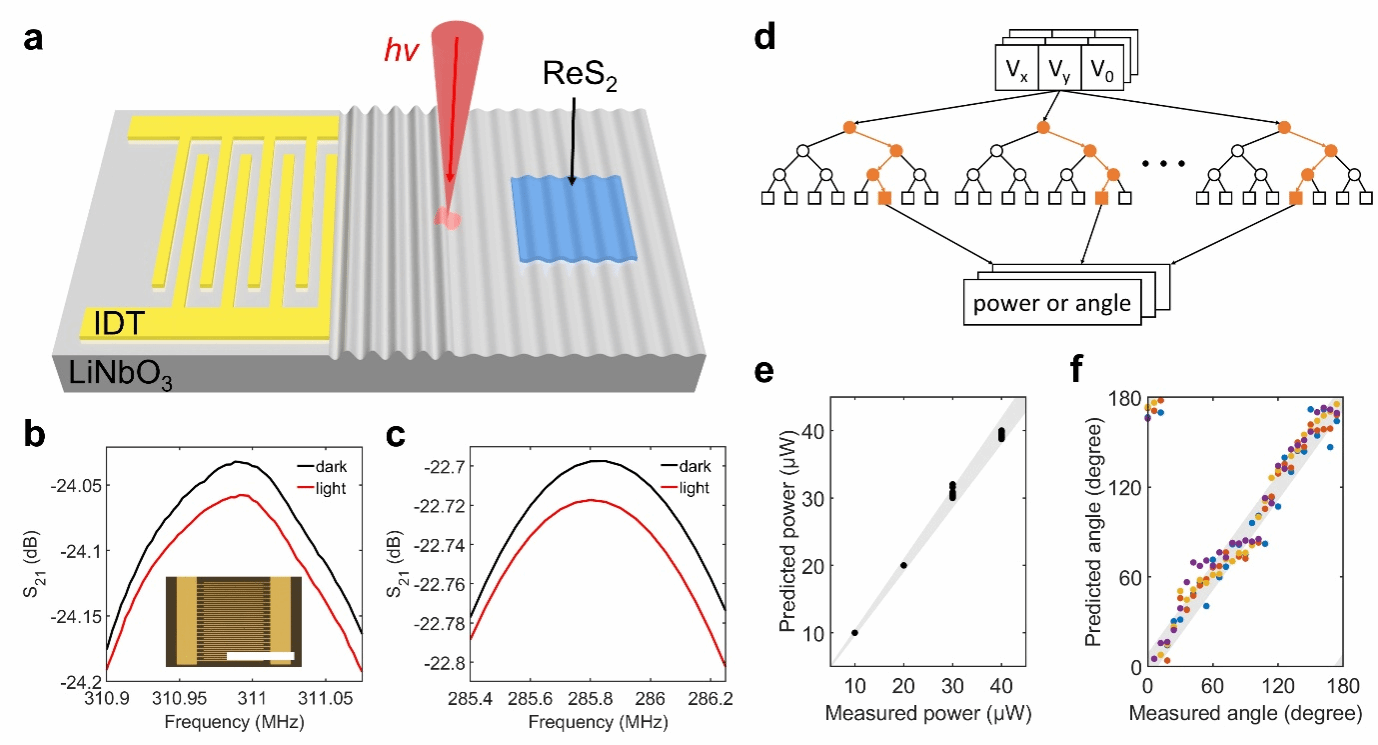
Figure 1. Photothermal-acoustic mechanism and multidimensional optoelectronic detection based on this effect. a, Schematic illustration of the photothermal-acoustic effect. b, Comparison of transmission parameters of interdigital transducers measured experimentally under different illumination conditions. The inset shows an optical image of the interdigital transducer; the scale bar represents 200 μm. c, Comparison of transmission parameters of interdigital transducers obtained from finite-element simulations under different conditions. d, Schematic diagram of the random forest algorithm. e, Prediction results of power by the trained algorithm. The gray area represents experimental error. f, Prediction results of polarization angle by the trained algorithm. Data point colors indicate the corresponding power levels. The gray area represents experimental error.
To validate this mechanism, the team measured the transmission parameter S21 of the interdigital transducer. In the focused interdigital transducer, illumination caused an overall shift in the transmission coefficient across the frequency spectrum, which was consistent with the changes induced by substrate heating. In contrast, in the planar interdigital transducer, illumination led to a decrease in the magnitude of the transmission parameter. By modeling the planar interdigital transducer using the finite-element simulation software COMSOL, the calculated variation in the transmission parameter under illumination showed excellent agreement with the experimental measurement results, providing strong support for the photothermal origin of surface acoustic wave attenuation.
Subsequently, the research team also found that the photothermal-acoustic mechanism exhibits polarization dependence, and its polarization-dependent symmetry is inconsistent with the propagation direction of surface acoustic waves. By employing polarized Raman spectroscopy to characterize the anisotropy of 128°Y-cut LiNbO3 substrates, they discovered that the intensity of the Raman scattering peaks displays the same symmetry as that observed in the photothermal-acoustic signals. Furthermore, the phase variation of surface acoustic waves also exhibits the same polarization-dependent symmetry. These findings reveal that the polarization dependence of the photothermal-acoustic mechanism originates from the symmetry of the 128°Y-cut LiNbO3 substrate.
Based on the aforementioned mechanism, the research team designed and fabricated a device consisting of few-layer ReS2 and two sets of orthogonally interdigitated transducers. By varying the acoustic wave power, they achieved dynamic control over polarization-dependent symmetry. Subsequently, the team used this device to demonstrate simultaneous detection of optical power and linear polarization. By applying surface acoustic waves in different directions or by not applying any surface acoustic waves at all, they were able to obtain three distinct optoelectronic response parameters. The research team then trained a random forest algorithm to extract the optical information encoded in these optoelectronic responses. The results showed that the trained model had a root-mean-square error of only 0.40 for optical-power prediction and a root-mean-square error of 10.21 for linear-polarization-angle prediction—both of which are smaller than the experimental error range, thus fully demonstrating the feasibility of using the photothermal-acoustic-electric effect for multidimensional optoelectronic detection.
Based on the aforementioned mechanism, the research team designed and fabricated a device consisting of few-layer ReS2 and two sets of orthogonally interdigitated transducers. By varying the acoustic wave power, they achieved dynamic control over polarization-dependent symmetry. Subsequently, the team used this device to demonstrate simultaneous detection of optical power and linear polarization. By applying surface acoustic waves in different directions or by not applying any surface acoustic waves at all, they were able to obtain three distinct optoelectronic response parameters. The research team then trained a random forest algorithm to extract the optical information encoded in these optoelectronic responses. The results showed that the trained model had a root-mean-square error of only 0.40 for optical-power prediction and a root-mean-square error of 10.21 for linear-polarization-angle prediction—both of which are smaller than the experimental error range, thus fully demonstrating the feasibility of using the photothermal-acoustic-electric effect for multidimensional optoelectronic detection.
This research was strongly supported and funded by the Department of Physics at Fudan University, the State Key Laboratory of Applied Surface Physics, the National Natural Science Foundation of China, the National Key Research and Development Program, and the Shanghai Municipal Special Zone Program for Basic Research. The first affiliation of the paper is the Department of Physics at Fudan University. Professor Xiu Faxian from the Department of Physics at Fudan University and Researcher Zhang Cheng from the Institute of Micro- and Nano-Electronic Devices and Quantum Computing are the corresponding authors. Dr. Jiang Chang, a doctoral student in Professor Xiu Faxian’s group, and Dr. Gu Jiaming, a doctoral student in Researcher Zhang Cheng’s group, are co-first authors.
The research group led by Xiu Faxian primarily focuses on the growth of topological materials, quantum control, and device studies involving novel low-dimensional atomic crystal materials. In the field of topological Dirac materials, the group is dedicated to the growth of new quantum materials, measurement of their physical properties, and the fabrication and characterization of quantum devices. In the area of novel low-dimensional atomic crystal materials, the group mainly investigates their electrical, magnetic, and optoelectronic properties.
Paper link: https://www.science.org/doi/10.1126/sciadv.aec4337
Xiu Faxian's research group website: https://fxxiu.fudan.edu.cn/

