Fudan University's Professor Xiu Faxian and Collaborators Discover Room-Temperature Intrinsic Nonlinear Planar Hall Effect
Recently, Professor Xiu Faxian's research group from the Department of Physics at Fudan University, in collaboration with multiple institutions, discovered a novel intrinsic transport response—the intrinsic nonlinear planar Hall effect (INPHE)—in the topological semimetal TaIrTe₄. The team revealed that this effect originates from the magnetization coefficient of the Berry connection polarizability dipole within the band structure. Remarkably stable at room temperature, this discovery opens new avenues for studying quantum geometry and developing room-temperature nonlinear electronic devices.
On June 12, 2026, the findings were published online in the journal Physical Review Letters (PRL) under the title "Room-temperature intrinsic nonlinear planar Hall effect in TaIrTe₄" (Phys. Rev. Lett. 136, 236302), and were selected as an Editors’ Suggestion. This work was a collaborative effort involving Fudan University (Prof. Xiu Faxian's and Prof. Xiao Cong's groups), Beihang University (Prof. Sheng Xianlei's group), ShanghaiTech University (Prof. Liu Zhongkai's group), the Shanghai Institute of Ceramics (Academician Dong Shaoming and Dr. Yang Jinshan's team), and The Hong Kong Polytechnic University (Prof. Yang Shengyuan's group).
Intrinsic transport responses, central to condensed matter physics, are determined solely by a material's band structure rather than extrinsic factors like impurity scattering, thereby directly reflecting the quantum geometric properties of electronic states. A classic example is the intrinsic anomalous Hall effect driven by Berry curvature. Recent studies have extended this to magnetic systems, identifying an intrinsic nonlinear Hall effect related to the Berry connection polarizability dipole.
In this study, the team selected the polar topological semimetal TaIrTe₄ as the platform. As a Type-II Weyl semimetal, TaIrTe₄ features abundant small-gap and band-crossing regions, significantly enhancing quantum-geometry-related transport responses. Experimentally, under an in-plane magnetic field, the device exhibited a second-order Hall voltage signal linearly proportional to the magnetic field and quadratically dependent on the driving current—hallmarks of the nonlinear planar Hall effect. Crucially, the signal showed a sinusoidal dependence on the magnetic field direction, allowing flexible modulation of its magnitude and sign.
To uncover the origin, the team combined ARPES experiments with first-principles calculations to systematically investigate the temperature dependence. The effect was found to be stable from 300 K to 100 K, exhibiting a nearly linear scaling relationship with longitudinal conductivity. This behavior starkly contrasts with previously reported extrinsic nonlinear planar Hall effects dominated by impurity scattering, pointing to a band-intrinsic quantum geometric origin. Calculations of the magnetization coefficient of the Berry connection polarizability dipole confirmed that the response primarily stems from small-gap regions near the Fermi surface, with theoretical magnitudes in excellent agreement with experiments.
Of particular significance, the team unveiled a previously unreported orbital magnetic moment effect. In contrast to traditional mechanisms dominated by spin coupling, the coupling between the orbital magnetic moment and the external magnetic field plays a dominant role in TaIrTe₄'s INPHE. This orbital mechanism may even hold in systems with weak spin-orbit coupling, suggesting that the intrinsic nonlinear planar Hall effect could be realized in a broader range of material systems.
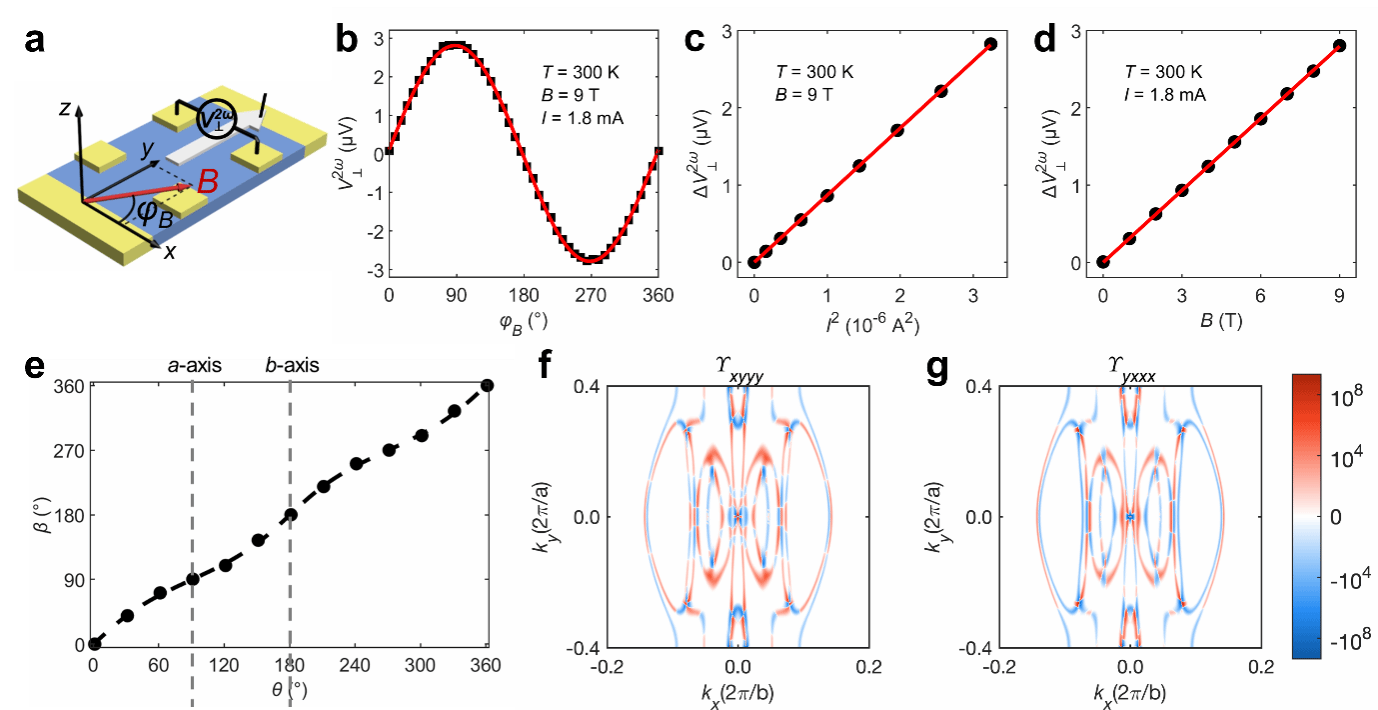
In summary, this work experimentally realizes the room-temperature intrinsic nonlinear planar Hall effect and establishes a direct link to the Berry connection polarizability dipole. This discovery not only provides a new experimental tool for probing quantum geometry but also offers fresh insights for studying intrinsic transport in polar and chiral materials. Potential applications include radio-frequency signal rectification, wireless energy harvesting, and room-temperature nonlinear electronics.
This research was supported by the Department of Physics at Fudan University, the State Key Laboratory of Applied Surface Physics, the National Natural Science Foundation of China, the National Key R&D Program, and the Shanghai Basic Research Special Program. Fudan University is the primary affiliation. Professors Xiu Faxian (Fudan), Xiao Cong (Fudan), Sheng Xianlei (Beihang), and Liu Zhongkai (ShanghaiTech) served as corresponding authors. Chang Jiang (Xiu group), Fan Yang (Sheng group), Yu Zhao (Liu group), and Jinshan Yang (Dong group) are the co-first authors.
Professor Xiu Faxian's group focuses on the growth and quantum manipulation of topological materials, as well as device research based on novel low-dimensional atomic crystals.
Paper Link: https://journals.aps.org/prl/abstract/10.1103/hbdj-2hgf
Group Website: https://fxxiu.fudan.edu.cn/

